
141 Godfather of Funk (James Brown)
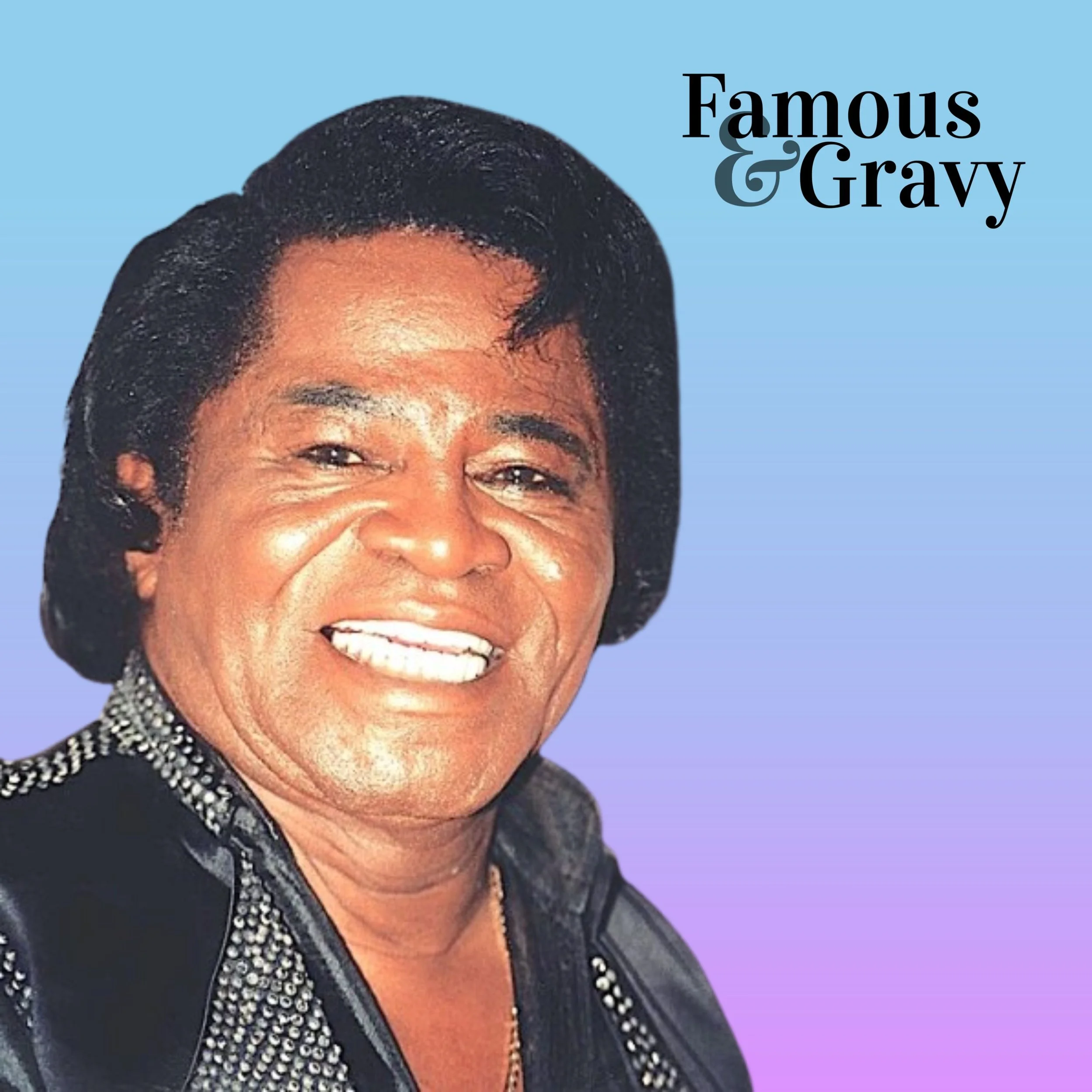
Listen on your preferred podcast player:





Stream directly here:
Transcript of this episode:
Nichelle: [00:00:00] This is Famous Gravy: Biographies from a Different Point of View. To participate in our opening quiz, email us at hello@famousandgravy.com. Now, here's the quiz to reveal today's dead celebrity.
Michael: This person died 2006, age 73. He was a political force, especially during the 1960s. He changed America's racial vocabulary, but he was never politically predictable.
Friend: John Lewis?
Michael: Not John Lewis.
Friend: [00:00:30] Strom
Michael: Thurmond. Not Strom Thurmond.
Friend: Was he an artist like Sidney Poitier, I thought?
Michael: Not Sidney Poitier. Not Sidney Poitier, but good guess. All right. According to his own account, when he was born, midwives thought he was stillborn, but his body stayed warm, and he was revived.
Friend: Whoa.
So he's a, he's a zombie politician- ... divisive politician. Okay.
Guy who overcomes the odds in many- Yeah ... many ways. Yeah. [00:01:00] Uh, Dick Gregory?
Michael: Not Dick Gregory. Good guess. All right.
Archival: LL Cool J, Public Enemy, De La Soul, and the Beastie Boys are among the more than 100 acts that have sampled from
Michael: his song Funky Drummer.
Okay,
Friend: I got chills when you dropped all those references on me.
Now I'm just gonna, like, throw out drummers' names. Uh, Max Roach.
Michael: Not Max Roach.
Friend: God, I feel like I, I know that song. This is a jazz musician.
Michael: Not a jazz [00:01:30] musician, but we're getting close. All right. He was known as, quote, the hardest working man in show business, among other names.
Friend: This is one singular person?
Michael: It is. It is.
Friend: The hardest working man in-
Michael: In show business, that's right ...
Friend: in show business, who also is a musician and a-
Michael: Uh, yes He's a force ... a, that's correct. His songs include I Feel Good, Cold Sweat, Get Up, I Feel Like Being a Sex Machine.
Archival: Uh, James Brown. It's James [00:02:00] Brown.
Friend: Like, James Brown.
Uh, James Brown. Um, James Brown?
Archival: Today's dead celebrity is James Brown.
Friend: Hit me. Ba, doo, doo, doo, doo, doo, doo. All right.
Archival: I'm against anything that, that partic- that, that, that relates with the word tom. But I've got to make an explanation for the people who don't understand what a tom mean. A tom is a man that don't have [00:02:30] his own insight in life. No trust or no confidence in himself. If he believed in himself, that he could survive, then he wouldn't go along with what another person say to make it.
See, I believe in myself, so, uh, so if I fail, I come to you or somebody else. I need help. But I still believe in me as a man, and you respect me this way. Be a man, you have no problem. I know people get a lot of pressure. You say, "Well, look at James Brown." He can say that he's a millionaire. There's [00:03:00] nobody in the world I'd like to identify with my people much better than me.
Uh, I'm a Negro. I don't wanna be nothing but a Negro. I, that's 'cause that's what I am. But that still don't stop me from being a man. See, I've got to be a man, too
Michael: Welcome to Famous and Gravy. I'm Michael Osborne.
Nichelle: I'm Nichelle Carr.
Michael: And on this show, we choose a famous figure who died in the 21st century, and we take a totally different approach to their [00:03:30] biography. What didn't we know? What could we not see clearly? And what does a celebrity's life story show us about ourselves?
Today, James Brown, died in 2006, age 73. Nichelle Carr, welcome back to Famous and Gravy. Thanks for making time for this.
Nichelle: Great to be back. I could not be more excited to be talking about James Brown.
Michael: So something I've been thinking about a lot, and I've been hearing from people in the audience, is, uh, w- who, who are, uh, you, [00:04:00] Michael, and who are your co-hosts?
You know, how are you inviting them onto the show? And my temptation is to talk about your academic credentials. You're an alum of Amherst College, no H. You're, uh, you have a law degree from Stanford, and you're, uh, from where I sit, doing, uh, well as a successful lawyer, you know, working with tech companies.
And none of that is relevant to James Brown. Um, so the question I think I wanna ask, like, how did you get ready for the James Brown episode?
Nichelle: Yeah. I read, uh, [00:04:30] several books. Um, I read a couple of books, um, both biographies of him, one that's quite definitive, known as the definitive one.
Michael: Excellent.
Nichelle: Yeah.
Excellent
Michael: one.
Nichelle: And then I read another one by James McBride called Kill 'Em and Leave, which is-
Michael: Yeah ...
Nichelle: par- it's almost memoir plus biography of James Brown, 'cause he has, he is a musician and a journalist himself, the author. Mm-hmm, mm-hmm. And so he's got his own take as well. But it, it covers from cradle to grave, just like RJ Smith does.
Um, and then I'm a [00:05:00] James Brown fan. Like- Yeah, yeah ... my family and friends know that I'm a James Brown fan. Like, every time James Brown comes on, they look at me like, "You love James Brown." I'm like, "I love James Brown." Yeah, yeah, yeah. So, um, I listened to a bunch of his music. Like, I got, I bought Star Time, which is kind of the definitive box set about James Brown- Oh
in the height of box sets, when that was like the thing. Yeah, yeah, back
Michael: when box sets were like, "Oh, you
Nichelle: got the box set." Like super exciting. Exactly. Yeah.
Michael: It was an investment. I- Yeah, yeah.
Nichelle: Exactly. I bought Star Time when it came out. Still have the physical box set of Star Time, even [00:05:30] though somehow I made the mistake of, like, lending CDs to family members, and now I'm like, "Give me them."
But anyway. So I listened to a lot of his music, read about him, um, watched as many documentaries as I could get my hands on. One of my favorite documentaries in life is actually about James Brown, so I've already seen it I don't know how many times, and I happily watched it- Is
this the one you, you told me to watch? Mr. Dynamite. Yes. Yes. That documentary is awesome. Mr. Dynamite. It's great. It's so good.
Archival: Without James Brown, the whole [00:06:00] trajectory of culture just goes somewhere else. Hit it. Everybody wasn't that talented. Everybody wasn't exactly as driven, that maniacal drive.
It's hard for me to think about my dad as the most important Black man in America because he was my dad.
As long.
Michael: You know, one of the things about Famous and Gravy is that we don't uncover information that nobody has documented before. We're not journalists that way. The whole point is to [00:06:30] scour everything we can find out about somebody so that we can come away with a different and fresh interpretation. So I think that's a good start.
Let's go ahead and get to the first line of the obituary. Let's just get started. James Brown, the singer, songwriter, bandleader, and dancer who indelibly transformed 20th century music, died early yesterday in Atlanta. He was 73 in Beach Island, South Carolina, across Savannah River from Augusta, Georgia.[00:07:00]
Okay. Uh, uh, you and I talked about this a little bit ahead of time. This, to me, looks a lot like the Prince, uh, which of course Nichelle joined us for the Prince episode. I'll just go ahead and read the Prince- Yeah, please ... first line. "Prince, the songwriter, singer, producer, one-man studio band, and consummate showman, died on Thursday at his home."
What's similar is that some of the same words. We have singer and songwriter appear in both. Um, and then there's like they seem to be [00:07:30] saving one phrase. So for, with Prince, it was consummate showman, which, or showman, however you wanna say that. And I remember you and I, uh, not really liking that all that much.
And here with James Brown, really, like we get indelibly transformed 20th century music. That's kind of the all ... I mean, where, where there's all these identities sort of attached to who he is. Four things, same thing with Prince. Um, I'm curious to know your initial reaction to the New York Times [00:08:00] obit.
Nichelle: It gets the facts right.
It's lacking in superlatives for me, right? Yes. Like, I wanna give them credit for even the fact of indelibly transformed 20th century music. That is a big thing. It's a big statement, so I'm not saying that they're, that they're, you know, doing him a disservice or sort of changing him. Yeah,
Michael: it's, it's in the direction of superlative in a way.
Nichelle: Right. But it's just not kind of ... I want it to be more, you know, exultatory, exultative. Yeah. I learned that exultative used to be a word back in the [00:08:30] 1500s, and it's become archaic, but it's still a word. I
Michael: was wo- Anyway. I was wondering if that's a word. Yes. I actually did look up indelibly- Mm-hmm ... 'cause it's one of those words that I've seen that, uh, I think I know the answer to.
Right. The definition is, uh, an adverb, uh, meaning in a way that is permanent, impossible to erase or wash away, or unable to be forgotten. It's a bigger word than it feels like it is. Indelibly seems like, like you sort of say it casually. It's like, "Oh, he indelibly transformed." But it actually [00:09:00] is like, you know, left his mark forevermore in a way that is, you know, concrete
Nichelle: He's one of those people who, uh, he, he is legendary.
Like, and where is legendary in here?
Friend: Mm-hmm.
Nichelle: Where's one of a kind? Where is- Yeah ... The One? Like, if you know anything about his biography, about his music, about everything, then some corner of re- some kind of reference to The One would be good. Like, I'm sure in the, in the, uh, Prince obituary, at some point there was some kind of reference to Purple, right?
Yeah. Yeah, yeah. The things that are signature about [00:09:30] them. Yeah. And The One is signature about James Brown, and it also telegraphs his idea of his uniqueness, right? So, and all that's missing. All the life and the color is missing from this.
Michael: There's a passage in the, uh, RJ Smith biography where it- they, he, he does a good job of listing out, he says, "James Brown had many guises, many names: Crip, Music Box, The Hardest Working Man in Show Business, Mr.
Please Please Please, Butane James, Soul Brother Number One, Skates, The Godfather of [00:10:00] Soul, his own bad self, the Sex Machine, Black Elvis, the Minister of New, uh, of new new super heavy funk, the Original Disco Man, Universal James." There was a lot available that they coulda had fun with. I- Yeah ... I don't, I mean, you know, Godfather of Soul or Hardest Working Man in Show Business woulda probably risen to the list for me.
Yeah. Yeah. Um, let's talk about the positives for a second, 'cause I do think that, um, I'm glad they did get these four things in there. Yes. Singer, songwriter, [00:10:30] bandleader, and dancer. Those are, in my mind, four actually quite distinct things- Yes ... that all deserve their own superlatives, right? Mm-hmm. Mm-hmm. Uh, it, so I think, like, he's an incredible singer.
He is an underappreciated songwriter. He is a, you know, m- we'll talk about it later-
Nichelle: There's he's the consummate. He's the consummate bandleader.
Michael: Right. Or- Or, or, or, or tyrannical, depending on where you
Nichelle: wanna go. I was about to say, yeah. Yeah. Where's the disciplinarian part? Yes. Right.
Michael: Or- That's tyrannical, yes
or, like, o- or, or [00:11:00] pioneering dancer, and I got- Mm-hmm ... more on that later. So-
Nichelle: Yeah ...
Michael: I, I actually wanna hone in on indelibly for a minute, though. Mm-hmm. So before this recording, I asked you to read an article by Chuck Klosterman. Um, this is from his book What If We're Wrong, and in that book he does some things where he tries to imagine, you know, modern day 300 years from now.
And- I'll see if I can sort of do the quick summation of this. He, he makes this case that, like, rock music, the moment, has kind of passed, and that at some point it will be [00:11:30] written in the history books. And the way history works is we often distill art down into a single biography. And then Klosterman goes through, all right, so if we're imagining 300 years in the future, who's that gonna be?
And at first, you know, you think The Beatles because they're such a, uh, I don't know, durable rock band, and they sort of set the template and... But he's like, "But we tend to go for one person." And so he tries to push on that question, and he goes through this argument between Elvis and Bob Dylan. And his logic [00:12:00] is sound there, but he kinda points out why that won't quite hold up.
And then he lands on Chuck Berry, and his, his argument is interesting for why Chuck Berry, that there is, you know, gets at the sort of racial roots of rock music. It gets at simplicity of song structure. Uh, gets at, you know, Chuck Berry being kind of a rebellious figure, you know, kind of embodies rock and roll in a way.
And, you know, it's an interesting and fun thought experiment.
Nichelle: And I think he goes even further when he talks about the [00:12:30] perversions of rock and how sexual rock is and how Chuck Berry was also perverted. And I think- Yeah . And that's right. That's true. There's, there's, there's
Michael: merit to it.
Nichelle: I- Yes. If you listen to the lyrics of rock music, you know, it is that.
It's all very sexist and all very sexual- Totally. I mean- ... and all of the things, and Chuck is, was that in life and in song. And
Michael: you're a rock and roll lady, I should say. Uh, you know, I know-
Nichelle: I am a huge fan of rock and roll, yes,
Michael: yes. But I remember w- early on when we met, you showing up with a GNR T-shirt, and you're like, "I'm all about Guns N' Roses."
I'm like, "No shit." Uh, anyway, um. They're
Nichelle: not my number one [00:13:00] favorite, but yes, they are, they are good. But they're up there. They stand the test of time, yes.
Michael: Okay. Well, I think, uh, you know, I, I hadn't thought about it at the time I read that Chuck Klosterman article. I think you can make a good case for James Brown.
The number one reason that wouldn't work is James Brown is not exactly rock and roll the way we think about it, but I do think that his impact on popular music writ large, like rock and roll in the broadest sense of the word, is the kind of thing that is actually indelible, is gonna be [00:13:30] remembered 300 years from now.
You can look at the people who point to him as their number one inspiration, Michael Jackson, Prince, Mick Jagger, David Bowie. I mean, like, people who are in the upper upper echelons of, like, who is who in rock history. I also think, you know, that extends even into hip-hop. He created funk. There is some, you know, sexuality and criminality in James Brown's, you know, biography.
I think that his legacy may come to dwarf everybody [00:14:00] else 300 years from now. I know I'm being a little hyperbolic with that argument, but... So in a way, I want a word bigger than indelible.
Archival: He's the world most sampled artist of all time.
You can take a piece of his and add it to your, add it to yours, and then that's just created a whole new era of how to do music and, and it's assisted people along the way with ma- with, with making their records cool.
I grew up in nightclub periods, and I've never, ever, ever knew a night where some element of [00:14:30] James Brown wasn't in the air.
Michael: Here's my other reaction to this obit, and I just got to get this out. I think, personal view, that they were kind of scared to go towards superlatives because I think that by the time he died in 2006, the last 20 years was less about the music and what a towering figure he was in the 50s, 60s and 70s.
And there was all kinds of stuff that we'll get into later that, you know, problematic, let's call it. And I think [00:15:00] that they soft pedaled the first line of this obit because they were scared to go there.
Nichelle: When you talk about going back to the Klosterman argument
When you say rock and roll in the broadest sense of the term, it's funny 'cause that immediately made me think of the Rock & Roll Hall of Fame- Yeah ... where they've adopted that broad, that broad meaning of the term. They're basically talking about popular music. Because let's be real, when the Rock & Roll Hall of Fame started, it was specifically for rock and roll music.
Yes. And once they realized that rock and roll music no longer was the [00:15:30] most relevant, I mean, Klosterman talks about this, and we all kind of know it, that rock
Michael: music has become- Yeah, Radiohead, R.E.M., Bowie. Yeah. Like, how do you... You know, these are very different forms of music. We can't really- Very different forms
Nichelle: of music.
Yeah. But not only that, it's not the most relevant for young people today, right? Yes. Like, hip hop and R&B have overtaken it, right?
Friend: Yes, yes.
Nichelle: And not that rock is not still there, but it's just not the most exciting music that's being made today. Right. And so they needed to expand what rock and roll meant and just kind of co-opt it.
Co-opt everything else- Yeah ... frankly. Which is fine, because then that [00:16:00] means that you're giving honor where honor is due and giving credit where credit is due. So to your point about James Brown, 'cause I wouldn't have tried to push James Brown into the rock and roll, uh, box like this. Like, I wouldn't have even tried to put him in this conversation with Chuck Berry and Dylan and Elvis.
Right. I would put James Brown separately to where you get to, which is popular music. Yeah. I would put James Brown in music writ large. It's bigger than that. It's, yeah, it's bigger than rock and roll, and this is my perspective as a Black person, it's even culture, right? Yeah. So to getting back to the obituary, I [00:16:30] think that the way that they just said music, they didn't say R&B music, they didn't say pop music, they just said 20th century music.
That's a
Michael: good point,
Nichelle: actually. I think they're getting at the same thing, that they recognize that his influence is just as broad as you stated. Because you mentioned David Bowie and Mick Jagger, and then, like, hip hop would not exist without James Brown, and frankly, like, outtakes from his band. You know what I'm saying?
Right. Right, right, right. Like, his crumbs we made an industry of, right? Yeah. Yeah, yeah. So, um, so I think there's that. And [00:17:00] to your point about the not using superlatives 'cause they wanted to soft-shoe-
Michael: Yeah ...
Nichelle: what was, you know, what we knew we'd have to deal with later, I appreciate that as a compromise. Like, I think it's quite knowing.
Michael: Hmm. You think so? Okay, you don't think, you don't think they're being, they're pussyfoot and you think that it's like, this is the right way- I think it's a compromise ... to handle the first line. Okay.
Nichelle: Yeah, I th- I think... Look, I'm giving it, uh... Not a fan. I'm a subscriber. You have bones to pick? Yes, exactly. Yeah, yeah.
I have bones to pick as a subscriber. Yeah. Um, so [00:17:30] I don't like giving them too much benefit of the doubt, but I would like to- extend some benefit of the doubt here and say that that was a compromise
Michael: Okay, that's a really good point, and I missed, I really actually missed, I'm glad you pointed it out, that they don't specify the music.
Mm-hmm. Indelibly transformed 20th century music. That actually is very much aligned with the Klosterman argument. We're, we're saying 20th century music, all music, R&B- Mm-hmm ... hip-hop, funk, rock and roll. Uh. I mean, you know, [00:18:00] uh, per- perform- music as performance and as a collective experience and, and as an industry.
I mean, there's, there's no way around it. I do think, though, my main critique of this is we need some kind of superlative- Yeah ... that points to number one that nobody else did this, and that the more you look at the legacy, the bigger it, it gets. And I think we knew that in 2006 when he died. I think that's only actually become more true in the 20
Nichelle: years since.
Absolutely. I mean, yeah.
Michael: All right. Well, let's go ahead and grade. So what do you got?
Nichelle: I, [00:18:30] I'm gonna stick with my score of seven
Michael: Seven? Yeah. Okay. Yeah. I was actually, uh, I was down a little bit. Your point about not specifying the music as ma- I'm gonna go benefit of the doubt. I'm gonna give it an eight. I'm gonna give it an eight.
Ooh, wow. I think- I'm gonna say- I know, it's a little generous. Maybe you've caught me in a good mood. I wish it provoked a bigger emotional response in me somehow. Mm-hmm, mm-hmm. And the fact that it's not is a little frustrating, but I think indelibly is actually a great word, and the, the sort of four, you know, [00:19:00] parts of what it meant to be part of the James Brown operation.
I mean, I think that there's a lot going on here. Yeah. And I also even like, and this is a small point, um, that they say he lived in Beech Island, South Carolina, across the Savannah River from Augusta, Georgia, because that is- Yeah ... so much the city he's associated with. Part
Nichelle: of his lore. Yeah. So, totally.
It's part of his lore, exactly, and they get in South Carolina and Georgia, and he's famously from Georgialina.
Michael: Georgialina. Which we'll talk
Nichelle: about. Yeah. Yeah. Yeah,
Michael: yeah, yeah. So. Totally. Awesome. Okay. Uh, well, let's go on to the next category, [00:19:30] five things I love about you. So here Nichelle and I will develop a list of five things that offer a different angle on who this person was and how they lived.
All right, what do you got for number one, Nichelle?
Nichelle: So here I have ever the performer. He is just the consummate performer. Um, it's who he was naturally, but it also was out of necessity. So he was always captivating, always holding court, always on, which I, you know, will say reminds me of my grandmother, who was very similar, [00:20:00] like the husky voice, round face, mercurial.
Um, so he felt he, he felt, um-
Michael: I love that you snuck that one in there, but yeah ...
Nichelle: he feels familiar. Right, right. Yeah. Truth be told. Yeah. Um, with all the love. Um, he feels very familiar to me, and, and always- Mm. Yeah, just captivating, holding court, and I think, and for James, though, I think it was also a matter of necessity.
So he wasn't born an orphan, but fairly quickly became one when both his mother and his father kind of left him [00:20:30] with other relatives to live with. Yeah. And when you're that, you really have to win people over, so you're constantly, you're almost singing for your supper.
Michael: Well, and an extremely impoverished- Right
you know, circumstances. Very impoverished. Right? I mean, his, he was with his, was it- It
Nichelle: was an elder cousin who he referred to as an aunt, yeah.
Michael: Right, and, and at a, at a brothel in, you know- Yes ... rural Georgia, right, and I mean, he's this little kid, right? Right, right, right. So he is like, you can sort of hardly overstate how poor he was, right?
I
Nichelle: mean- Yeah ... clothes and food and all that stuff. We're talking [00:21:00] 1933 in the Deep South. Right. Just imagine, 1933 in the Deep South. Yeah. We're not, we're not
Michael: rolling in it here. Imagine that. No.
Nichelle: Right, right. Exactly. So, um, so yeah, so he really had to, it, people have described him as this, like easy to like and easy to love.
Mm-hmm. And you have to be when you, when no one has any real A need or obligation to take care of you, you have to do that. It kinda reminds me of Gregory Peck when we talked about him, where- Yeah ... he spe- specifically said, "If your place in the family is not secure, it's [00:21:30] best to express gratitude." And James, if not specific gratitude, it was certainly, "I'm gonna entertain you.
I'm gonna make it so you want to be around me, so you want to spend time with me, so you'll keep me around and hopefully take care of me," right?
Archival: As a boy, I shined shoes. I,
I worked at the car lot, I worked in the sawmill, I picked cotton, danced for nickels and dimes to pay the rent.
Well, we had to pay $5 for rent per month.
18 people lived in a home that couldn't get it up to save their life. 18 people. [00:22:00] And I danced for the soldiers, and 20 minutes, I had $19.
Nichelle: So later on in his career, he had to win audiences over, very specifically win audiences over, and we'll talk about it more, but you know, one of his earlier stints as he was becoming a professional musician was filling in for Little Richard.
Yeah. And when I say filling in for V- for Little Richard, what I mean is replacing Little Richard, where audiences were being told they were going to see Little Richard, and they were not seeing Little Richard, they were seeing James Brown.
Michael: This story is great. So, like, the way I, I'll, I'll just, I'll just hop in to fill in the [00:22:30] blanks real quick.
So, like, you know, Little Richard and, and, uh, James Brown I guess knew each other somewhat. Little Richard was ahead of the curve in terms of his success.
Nichelle: So he saw James and the Famous Flames perform, thought they were good, introduced them to his manager.
Michael: Yeah, but was this on the, like, Chitlin' Circuit or whatever they call
Nichelle: it?
Yes, the Chitlin' Circuit lives now and today. Yeah. Yes, it's always the Chitlin' Circuit- Yeah ... when it's Black performers performing for Black people. S-
Michael: so Little Richard was in a place where he got, he, like, signed a record deal, and Little Richard was on the [00:23:00] hook to do all these performances, and basically the manager was like, "James Brown, just pretend like you're Little Richard.
Go out there and do your best, you know."
Nichelle: And to be clear, they didn't just have the same manager. Little Richard introduced James to his manager. Like, Little Richard did James a solid.
Michael: Yeah, yeah.
Nichelle: So- Well, and, but, and it's- Let's not forget that ...
Michael: you can see some of the i- points of inspiration for James Brown in terms of the scream and the, you know, the- Well,
Nichelle: that's how he learned the scream.
He had to impersonate Little Richard- Yeah ... to fool these audiences. And luckily, you know, this is obviously before the [00:23:30] internet and before widespread television, so- So nobody knew what Little Richard looked like, yeah ... not everybody knew what Little Richard looked like. Yeah, yeah. So James could do it. And so again, this idea of winning audiences over and, um, and kind of, I w- I keep wanting to say sing for your supper.
It wasn't exactly that, but it was quite close.
Archival: So they took us to a little town called Toccoa, Georgia, and, uh, they took us to a little prison outlet, like, for, for, for people that had been locked away, and we played for them. And although we weren't famous, but we played for this thing, this, uh, [00:24:00] um, association there.
And when I played, then a group came up to me and he said, "We're the Famous Flames." And so what they did was they wanted to do a song on my show, and I allowed them to, although I hated it after I did it, 'cause they sung Please, Please For One Hour, and it was my show I had to wait till they get through singing.
I wished I had never let him get up there. James Brown got on his knees, he fell down, he didn't have no cape, and he fell, he fell, he pleased. He got [00:24:30] through begging. I wanted to give him something myself, and I didn't have nothing but s- some coffee.
Nichelle: And then there's this idea, and he was so good at it, like, he was himself.
And, um, it's very much, you think of this idea of, like, a crossover artist, 'cause he was... But when I say he was winning audiences over, they were crossing over to him. Like, nowadays, it's all about the crossing- This is one of
Michael: my favorite lines from the RJ Smith- Yeah ... is that he talks about that. He's like, "We...
You should not understand James Brown as a crossover artist who's trying to appeal to [00:25:00] white audiences. It's the other way around, is that he wins them over, they cross over to him." And I wanna linger on this for a second, because, uh, you know, I think this is gonna come up throughout the conversation, and, and w- you know, we're gonna save some of the problematic stuff for later.
I mean, the way I understand him is, you know, there's a, a, abandonment, there's, you know, real material and emotional needs from a young age. And th- this actually relates to something I have a little bit later on, but he, he is, I think, you know, seeking [00:25:30] attention and seeking love, and is very good at, you know, captivating an audience and figuring out how to, "How do I get people...
How do I have some control in this situation, and have people, like, admire and be impressed with me?" Part of the reason he is such a incredible performer, and it is in all four of those domains, it's with the music, it's with the dancing, it's with the songwriting, it's with the, the whole show- The band ... the cape- Yeah
oh, the band, all of it, right? The whole, the, the whole theater of it i- [00:26:00] is because, you know, he, he is dogged in his, you know, pursuit of capturing that attention through, through performance.
Nichelle: Yeah, and I think that's true of most performers. Like, they'll tell you that there's, there's a need, there's a void that they're trying to fill with adoration, right?
Yeah. And so I do think it also still comes from a place of integrity, 'cause with James, he, like, says in his own words, "I'll always come to you from my heart." Yeah. And the reason why he gets the nickname the hardest working man in show business is because he left it all on the stage. And to your point about [00:26:30] the theatricality of it, I think it's worth not missing that it was literally a James Brown revue at its peak- Yeah
where there would be other acts performing before him, then he would perform. He developed the cape routine, which was based on a preacher that he really idolized when he was young. Yeah, yeah, yeah. And so it was an absolute theatrical show, and it was about controlling the room. But it's controlling in this need of you are this insecure orphan who, if you don't [00:27:00] win and earn people's love, how are you gonna get it?
And he was out- Yeah ... there earning it. 100%. So I do think it, there's integrity. It's, it's not just ego. It's, it's like, it's a very real need.
Archival: So now, ladies and gentlemen, it is star time. Are you ready for star time? It is indeed a great pleasure to present to you at this particular time, national and international known as the hardest-working man in show business, man that sang I'll Go Crazy.
Mr. Dynamite, the amazing Mr. [00:27:30] Please Please Himself, the star of the show, James Brown and the Famous Flames
Michael: Yeah, no, I mean, and I think what happens with celebrity is ego can get supercharged, but, like, the, the roots of it are, are very human. And, and I think that they're, they're als- I mean, you mix that with a certain, not just dedication, but obviously, like, raw talent, and, and that's part of how, how he got there.
Okay, that's a pretty good segue into my thing number two. [00:28:00] I think I'm just gonna call this, this is... I don't know if this is the right way to put it. Get up off of that thing.
Archival: Get up off of that thing '
Michael: Cause I think like Get up off it. 'Cause, okay, I, I, I have some, you know, reticence to get too excited about, um, the v- self-determination as a virtue.
That said, the, like I, I do admire that about him. I do [00:28:30] think that it is hard to overstate just what he overcame in his life to achieve success, right? I mean, we talked a little bit about his upbringing as essentially an orphan, you know, no indoor plumbing, raised in a brothel. And, and then, you know, I mean, he is incarcerated at a pretty young age, right?
And what's the story here? Like, he, he, he was being teased for not having the right clothes at school, and then he, like, stole clothes? I mean- Is that how it'd go? Yeah ...
Nichelle: he had originally, he had been sent home for not having sufficient clothes for school.
Michael: [00:29:00] Right.
Nichelle: And so, so and then, and, oh, he of course was teased as well, so he started stealing clothes so that he would have clothes to wear.
And once you start stealing clothes, you're like, "Well, I can steal other things, too." And he got to the point- Like a car ... of stealing cars. Yeah. Yes. Yeah,
Michael: yeah, yeah, yeah.
Nichelle: And eventually got caught. Yeah. That's
Michael: basically juvie, right? It's in juvie that he begins to k- kind of develop his music. I think that's where he got the moniker, uh, Music Box?
Nichelle: Yes, he did. Yeah. But he had been playing, he learned organ when he was quite young, so he was already musically inclined- Yeah ... and he really [00:29:30] cultivated it in juvie because, again, that's how you, it's a way to, what, win friends and influence people, let's say, right?
Michael: So okay, so that's part of what I, I like in this get up off that thing, is that there's a, uh, self-determined life.
But it's also, I, I think you have to put him in historical context. I wanna talk about this with you because h- his rise, you know, is in the '50s and '60s, and he begins to have hits, and we could, you know, go through Try Try Me and all that. Um, I think, though, that [00:30:00] h- I mean, one, he is not, you know, out of central casting for a Black superstar in the '60s un- until he is, right?
That he is in some ways somebody who is s- succeeding despite appearances, despite what he kind of communicates in his, his persona and his personality. I was hoping you could help me with some of this because I started thinking about, uh, Muhammad Ali and Sidney Poitier, who we've done on the show- Oh, yeah
and I came across the term [00:30:30] respectability politics, right?
Nichelle: Wait, wait, wait, wait, wait. Yes.
Michael: Okay. Yeah, yeah, yeah.
Nichelle: It's the politics of respectability. I mean, now you're getting into my number three. Are we ready to do that? 'Cause this is- Well,
Michael: well, okay, maybe, maybe we will- ... this is a lot of that ... in a second. I think, and I think it'll probably dovetail.
I don't wanna actually get into his p- specific politics yet, but I, I-
Nichelle: No, not his politics, his Blackness, the respectability
Michael: politics Well, his Blackness,
Nichelle: right. The r- the politics of respectability is a Black thing- Right. No,
Michael: okay ... here in America. And I didn't know that until, you know, I started doing a podcast about Black celebrities, but-
Nichelle: You guys don't have to worry about being respectable.
W-
Michael: where [00:31:00] I, what I was thinking about was- Y- wh- when you look at his success in the early '60s, you know, in the sort of early stages of the civil rights movement, i- i- i- you wouldn't have j- thought that he was going to be the one, this number one performer. Like, peak James Brown, both musically but also in terms of cultural importance, really begins around the late '60s, maybe around the time of MLK's assassination in '68, and extends [00:31:30] into the '70s.
And that, and that he happens to be somebody who is in the right place where he's got, you know, a lot of credibility with audiences and a lot of successful songs, but then he comes to represent something more a- at this moment of crisis in the politics of respectability, if I'm understanding that term correctly.
Archival: We all love Dr. Martin Luther King I know him personally, and he was a fine man.
The [00:32:00] very fact that white public officials asked Mr. Brown to speak to some of these communities in the wake of the murder of Martin Luther King, that was fraught with contradiction. Mr. Brown had credibility. He could get people to cool out, understand that Black power meant building your community, not tearing it down.
But at the same time, there were whispers that you're operating with the establishment.
Nichelle: So the politics of respectability has a lot to do with, yeah, figures you mentioned like MLK. It was how we were [00:32:30] winning the nonviolent argument in the Civil Rights Movement. But James was doing something different. He was, the term unapologetic is overused these days.
Yeah. He was unapologetic. He was super Black.
Michael: Like, it, I, okay, so this is, this is helpful, 'cause I've been trying to think of, like, who, who, who, who are the Black celebrities of this era, you know, and, and how do they, um, break on either side of that? Sidney Poitier, I was thinking about Jackie Robinson, Muhammad Ali, uh, Belafonte.
I, it, it kind of-
Nichelle: Literally all of them were on one side. Yeah. Muhammad [00:33:00] Ali is the only one who was on the other side with James.
Michael: Ri- well, but that's the thing, is that, that James was- Of the, of
Nichelle: the ones you mentioned, I can categorize them that quickly, like boom, boom, boom. That's it.
Michael: James Brown seems to have, like, carried over from this moment, and it does seem like, am I wrong in that MLK's assassination is the sort of, uh, a, a turning point for that idea?
Nichelle: I don't think so, because I think even before he passed, we had folks like Stokely Carmichael talking about Black power.
Michael: Yeah.
Nichelle: Malcolm X's assassination in 1965, maybe, [00:33:30] but that might come closer- Yeah ... 'cause the Black Panther Party came in 1966. So there was a time when we started to question the politics of respectability, and to your point, it's because it seemed fruitless.
If you were gonna kill the one person who was trying to make this easiest on you, if that's the one you're gonna kill, we're done here.
Michael: But I think what's interesting is we're talking about people who were both, you know, s- spokespeople and had ideas and were engaged in political activity. We're also talking about pop culture, and, you know, this is what I mean about [00:34:00] get up off that thing and self-determination.
James Brown really does arrive in that sort of, like, hyper-tense moment and is the guy for the job there, you know, a sort of unlikely figure in that regard.
Nichelle: And to your point, it's, it's not, it's not binary, because let's be very clear. He was always impeccably dressed. Yeah. His hair was always impeccably done.
Yeah. Yeah, yeah, yeah. Even when he stopped wearing his hair straightened, it was still impeccable. So there was nothing scruffy about him. There was nothing where he was, you know, like [00:34:30] doing the opposite to rebel against it. He was, again, he was just do- he was in his own lane doing a different thing. He wasn't, you know, he wasn't one or the other, but he was unapologetically doing his thing.[00:35:00]
Michael: Even if it's not the right word, let me linger on unapologetic for a second. He looks, um, I... It's, if, if I were to, um, put myself in the mind of racist white America in the 1960s, James Brown looks like a threat, right, in a way that some of these other figures we're talking about do not.
Nichelle: [00:35:30] MLK was called the most dangerous person in America back then.
Michael: I'm not saying they're not dangerous figures to, uh, you know, a racist white America.
Nichelle: They were all considered threats.
Michael: Absolutely, but I think that it's exists a little bit on a spectrum of who is more scary, especially in 1960s. And I think James Brown, because he's confident, because he's, you know, self-determined, and assured and, you know, swagger, and sexual, and all of it, I think, like, I...
It's sort of surprising to me that he experienced as much [00:36:00] success as he did when he did, d- despite all that.
Nichelle: But I think you're forgetting the tradition of the minstrel. James Brown was a song and dance man. So he could be dark, he could be aggressive on stage, but he still was a song and dance man. And look, he was, again, nothing minstrel about him, right?
Like, that is a very kind of harmful tradition, yada, yada. But if you were so inclined to see these folks as, to see Black people who are kind of self-determined as threats, [00:36:30] which much of America was, and that's, that's all... I'm not trying to contradict you, but that's a point I just want us to remember, that back then- No, I think it's good, yeah
even MLK was a massive threat to the United States, right? So, but I, but I, yeah, but what I wanna say is if you were so inclined to think along those lines, you could even find an exception for James Brown, 'cause remember, he lived in the Deep South his whole life. He spent a few years in the North, but basically lived in the Deep South.
Because he was a musician, and white America was used to processing and digesting Black people as entertainers- Mm-hmm ... he could [00:37:00] be this dark skinned, stocky, assertive Black man.
Michael: Yeah. And sexual. Let's not forget sexual. Yes, yes. Sexual is the biggest thing.
Nichelle: Yes. I mean-
Michael: Yeah ...
Nichelle: every move he's doing is sexual. I mean- Yeah
so yeah, people were freaking out about everything there. But I just want us to remember that part of what helped him To have these audiences come over to him without him changing who he was, was the idea that entertainment and music from Black people, white America was used to. So that, I [00:37:30] think, helped allow him to be-
Michael: Totally.
Okay ...
Nichelle: in his own lane as well, you know? Whereas-
Michael: I think we could talk about this all day, but- Yes,
Nichelle: we could ...
Michael: but, and I don't mean to move us on too quick. I think where I was coming from is that my view of history at times can be oversimplified and cartoonish, and the closer I look at two figures, James Brown and Muhammad Ali, it makes me think about, like, how pop culture has this way of pushing on norms and challenging and advancing, even when...
And, and [00:38:00] sometimes that's explicit, and sometimes it's implicit. I think he's an interesting figure in that way, and, and that's all I think I really wanted to draw attention to. Like, there, there are, there is a debate to be had of how do we view him in this larger conversation about the respect, about respectability politics?
Archival: Black is a thing that was, uh, basically put on a man, uh, on a, on a, on a bl- American Black man in America. And, uh, hey, I'm Black and I'm proud, but I really would, don't wanna have to say I'm Black, and [00:38:30] you have to say you're white. I wanna say that we're people, and that we're brothers, and we got the same fight.
But now, if you step on my toe, then I gotta defend myself as a man, same thing you would have to do.
Nichelle: And I would just say to kind of sum it up that their success back then was always in spite of. Like, people were hyper-aware.
Michael: That's, I think that's exactly my point. It, it, it's despite the odds, yes.
Nichelle: Right.
Exactly. Yeah, exactly. Against all odds. It was in spite of that.
Michael: Do you wanna say more about personification of [00:39:00] Blackness as thing number three for your point number three? Yes. I mean- Okay. Yeah, I mean- I mean, my goodness ... again, we could talk about this all day, but, like-
Nichelle: Yeah ...
Michael: where are you going with it?
Nichelle: We've t- yeah, we've, we've gotten into it, but I think you've, you spoke about it very well from the white perspective, and now from the Black perspective, right?
Michael: I'll just mu- I'll mute my microphone-
Nichelle: No, no ... you know?
No, but it's, I'm just saying that it's kind of like the flip side of the same coin is what we're talking about here, right?
Michael: Yeah.
Nichelle: So, you know, he was very much the muse of the Black Arts [00:39:30] Movement. So the Black Arts Movement are the artists, kind of the artist wing of the Civil Rights Movement through, say, the mid to late '60s and on into the '70s and what have you.
And so-
Michael: Poets, authors, musicians-
Nichelle: Yeah, poets- You know, yeah ... authors, musicians, again, saying a lot of the same things, um, as the Civil Rights Movement and the Black Power movement. And so we call that the Black Arts Movement. And so those folks, many famous poets that we, poets that we know now, um, and writers like James Baldwin I think would be part of that as well, Nikki Giovanni, Sonia Sanchez, um, who-
Michael: Who [00:40:00] we've interviewed- Yes
but, uh, just as a quick plug for the Black women of AMERS.
Nichelle: They would call James Brown the personification of Blackness. They did literally call him that, and I think that's still true. Like, that's how I feel about him. Like, when I talk about him feeling familiar and him reminding me of family, that's what I'm talking about.
Nelson George, who's one of the, you know, kind of great culture critics of our time, calls James Brown perhaps the ultimate example of African-Americana, and I think- Hmm ... that's exactly right. Like, there's so much of Black culture that we see embodied in [00:40:30] him, right? Mm-hmm. Like, his whole demeanor and countenance reminds, for African Americans, reminds us of our elders from the South.
It feels familiar. The music, the impact of his music, you know, Questlove says, like, some throwaway, some song that they didn't like, like, birthed his entire movement, and that is true. Like, what he has done and his impact is just, he is the source. Like, so much of what we live and breathe today, again, Nelson George, he's the root and everybody else is just a branch from his [00:41:00] tree.
So the way that he carved his own lane of Blackness that was giving nothing away Is exactly how we would like to live. That self-determination that you talk about- Yeah ... is how we would like to live. Just his foundational role, and again, the founding of hip hop can't be overstated, his global influence.
You know, Bob Marley emulated, and other Jamaican artists emulated James Brown.
Michael: Yeah.
Nichelle: He has his own personal slang reference term in Brazil.
Michael: Yeah.
Nichelle: Um, you can look at
Michael: [00:41:30] towering
Nichelle: figures in- Yeah, he's an international star. A- And to this day, yeah. Yeah, you look at towering figures in Africa, like Fela Kuti, who is obviously influenced by James Brown.
Yeah. I just... And he lasts today, and we don't even know it. He's so much the fabric. Like, I gotta mention how Bruno Mars, his entire thing- Yeah,
Friend: I was thinking about him ...
Nichelle: his whole thing- Yeah ... is James Brown. You know what I mean? It feels much more like an homage rather than appropriation from him- Mm-hmm
'cause he seems to recognize that. The young people may not be aware of it, but he is that. So he is what, what I like to say, the apotheosis of Black culture. He is the peak [00:42:00] example of Black culture.
Michael: I love how you also said like family, and I wanna come back to that, 'cause I think that there's another side to that coin as well.
Um, I wanna keep moving along, so I, I'm gonna give you my thing number four. We kinda talked about it a little bit, but um, I wanna talk about him as a dancer. Because one of the things about that documentary you mentioned, Mr. Dynamite, is I, I don't, I don't think I realized how, uh, uh, really the word is explosive, his dancing is.
It is unbelievable, and there are some great quotes in the [00:42:30] RJ Smith book about this. "The buck dance was done flat-footed and low to the ground. So much of Brown's dance was performed with his feet. He was a shoeshine, a, a shoeshine, a boxer who studied at the feet of Bojack, who danced across the ring, a man who tended to hold his upper body in check, not frozen, but coolly reserved, letting a little sway or shoulder dip telegraph a wealth of insinuation.
He lived down low. The steps inspired the music. You wanted to inspire the people on the floor, so you played music meant to [00:43:00] feed the flux. Contrarily, when you got back to the hotel room, you might knock out a song meant to coin the motion you observed in the house just an hour before. A song inspired by an action, a way to put your little thing over on what they did, but first came the dance."
I see in many ways that motion and dance and his a- athleticism and his moves in some ways preceded the music. There's another, one more passage I'm gonna read here. "He was the embodiment of what [00:43:30] Zora Neale Hurston called, quote, 'dynamic suggestion,' a quality she considered the essence of Black dance.
However explosively or fiercely he moved, Brown telegraphs that there's more we don't get to see. His actions exert maximum impact with a minimum of exertion, coolness, with a withholding that compels the viewer to follow the gesture through in the imagination. His dance wasn't supposed to be appreciated with detachment.
It was meant to pull you over to where he was, to engage you [00:44:00] in the act. You can't sit still." That's how I feel when I watch James Brown, right? I'm on one hand kind of intimidated, but on another hand, like, his dancing and his movement looks so, uh, improvised and unrehearsed, but so present, a- so much so that it almost feels like he's a dancer before he's anything else.
There's even other stuff in this particular chapter where RJ Smith talks about him learning that as an orphan, that the [00:44:30] more I could surprise them with dance, the more coins they'd throw my way, the soldiers passing through the brothel or whoever it was, right? And I thought that that was actually a really great way of understanding his excellence, that he is all these other things, but if I had to rank the four things that are mentioned in the first line of the obituary, I might put dancer number one.
So that's my thing number four.
Nichelle: Two things on that. One, I think to your point, this idea of dance coming first, I mean, there's this idea that it [00:45:00] is because we move through space that we as animals have evolved and developed in a way that plants don't, right? Yeah. The way that our brains have evolved, the way that we...
'Cause plants are living beings, animals are living beings. How are we different? Animals move through space, therefore we have to react. We have to recognize. Yeah. We have to predict. We have to respond to all the things we encounter as we move through space. So this idea of motion as being foundational makes a ton of sense.
Dance is also the thing that, [00:45:30] um It's an expression. When there are no words- Mm ... there is dance, right? You know what I mean? Like, dance could be when you've gotten to the place where words are not enough, words are not sufficient. There is dance, which is why in church you have this thing, it's called shouting.
Yeah. The term is shouting. It is dance. There is no verbalizing to it, and it is called shouting, and it is dancing in response to being moved by the music. Now, I do have a counterpoint to your number one, though- Okay ... I tell you.
Michael: Okay.
Nichelle: I think he is, like we [00:46:00] talked about in the obit, he is deeply underappreciated as a composer.
Michael: I agree.
Nichelle: I think that, yeah- I agree. Yeah, yeah ... his, his work as a composer becau- And look, he didn't read music, and he knew that, and the musicians he worked with are the best musicians in the world because he knew music so well and he could play, you know, the organ and the piano passably, but he didn't read music.
He, so I think he gets overlooked in terms of his composing. And I gotta say this, this idea about creating funk, it's like [00:46:30] him and his musicians birthed funk through composition. Yes. You know, you talk about this idea of going back to the hotel room after a show. That's not what James Brown did. Yeah.
James Brown took his band back to the recording studio-
Michael: Yeah ...
Nichelle: to start writing more songs after a show. So you wanna talk about being inspired-
Michael: And it is a- ...
Nichelle: they did that ...
Michael: disciplined system. I, I keep wanting to go back to the word tyrannical. Maybe that's not fair. Yeah, no.
Nichelle: Um- I think, no, I think tyrannical is fair
but, but he,
Michael: he runs an unbelievably tight, militaristic ship, [00:47:00] uh, you know- Absolutely ... and a system with, wi- within which, you know, his musicians find opportunities, this idea of creativity emerging from constraint.
Archival: What kind of things would you have to do to get, like, a five or a $10 fine in the, in the
show?
Missing notes deliberately and not paying attention. I, I demand it.
I could read his eyes. It's like I heard that and I think that Mr. Brown could hear every instrument, every voice that was singing behind him. He just knew who would make a [00:47:30] mistake.
Nichelle: I just wanna say to explain what we were talking about with the one, right? Mm. And his creation of funk as a composer, right? He and his band, they knew when they birthed a new form of music that was funk, and it had to, it has to do with James' whole, his whole need to kind of be in control, to be in charge.
'Cause his whole thing was, "I'm not doing the passive downbeat two. No, the one is gonna control." Yeah. The one. Yeah. And so that's [00:48:00] how funk is built. It's built off of you hit the one. The accent is on the one. That's not how popular music works. The accent is usually on two and the four. Dun, dun, dun. And that is funk.
That is the root of funk. And so the first true funk song, Papa's Got a Brand New Bag, he knew he had created something- Yeah ... that was revolutionary. He literally says it, if you listen to the long version of the song, he says it at the beginning, "This is a hit." There's
Archival: a lot of words here, man. That was good, though.
Yeah, it's a thing. That was very good. Preach it, man. This is[00:48:30]
a hit
Papa's in the scene. It ain't too hip, but that new breed thing. It ain't no drag. Papa's got a brand new bag.
Nichelle: So [00:49:00] just him as a composer, I don't want that to be lost because this, this, you know, creating art through acts, like extreme acts of discipline, gave us the brilliance that we have today.
Michael: All right, what do you got for thing number five?
Nichelle: The artist and the advocate, the political animal. Okay. So this is James Brown and his politics direct. So to your point about how dance was communicating something even more powerful- Yeah ... and where I'm like, "Well, he also said it straight out, too," you know, he did that as well. Like, he has a song that literally the title is I Don't Want Nobody to Give Me Nothing.
Open Up the [00:49:30] Door, I'll Get It Myself.
Michael: Yeah.
Nichelle: So James Brown was... And then he has a spoken, he literally has a spoken word poem that is brilliant called King Heroin where he's making a political statement, so he's very political.
Michael: But his politics are, like, if you go through it, it gets complicated 'cause in, he stumps for Hubert Humphrey in 1968, the Democratic nominee after RFK had been assassinated and LBJ had dropped out, and then in '72, he, uh, is, gets behind Richard Nixon, and later in [00:50:00] life has a kind of friendship with Strom Thurmond.
I mean, he's, he's, you know, I don't wanna put him in a political category, but he's not necessarily as politically aligned as a wa- in, in a way you might think, right?
Nichelle: Right. But before we get to that, I wanna talk about, 'cause that is all true, and I think what that shows is that he, um, again, made his own lane.
Like, he was not going to be categorized. Yeah. And there are ways to think about the way he approached politics, but I just, I wanna be sure that we make the point that [00:50:30] he wanted to be an agent of change, right? There are not a lot of celebrities that people wanna hear their political views, you know? That we don't expect artists to comment on it, but people absolutely wanted to know what James Brown thought, because he was making, I think he was making songs that talked about it.
Michael: Well, those are two different things, and I actually, I, so I, I'm not saying I disagree, but I thought that there was pressure for him to develop a political opinions and that he didn't shy away from that, but I didn't [00:51:00] exactly see him proactively pursuing that. I felt like, you know, his hand was forced a little bit to take stances and to become a spokesperson by the times, but maybe I'm wrong.
Nichelle: I think he's always been pretty outspoken. I think he was always quite outspoken.
Michael: I do sort of see him, in a way, publicly wrestling with his own political ideology, a- and sometimes it's not, I don't wanna say inconsistent, but I'm trying to, like, I, I, I felt like that was something that was sort of [00:51:30] thrust upon him that it's not obvious to me that he would've gone that direction, but, but he kind of had to given his importance- As a pop culture figure.
Nichelle: I think he wanted to. I think he really wanted to. You think
Michael: he wanted
Nichelle: to? Okay. Yeah. I think, 'cause he- I see that. I mean- Look, he, he has always wanted the uplift of his people, to use- Hmm ... a term from that era, right? Yeah. Like I said, he wanted to be an agent of change, but he wanted to retain his creative freedom.
So if there's ambivalence, then that's where it is, that he still wanted to be fully an artist, but he wanted to be part [00:52:00] of change. Like, he lobbied really hard to go, uh, perform for the troops in Vietnam. They were not- Yeah ... having Black artists do that. Yeah. Black artists weren't on the radio that soldiers had access to, yet so many of those soldiers were Black and of color, and he had to lobby really hard to do
Michael: that.
So- And he took flak for it. I mean, and certainly he took flak for getting behind Nixon in '72, and, yeah.
Nichelle: Well, I mean, that's a, that's a different thing. Like, he wasn't getting behind Nixon because he necessarily supported the Vietnam War. He wanted to be there for his Black brothers in [00:52:30] uniform. Like, that was what that was about.
And with Nixon, it was because he believed that economic empowerment and education were the solutions to racism. So if someone... And he was a capitalist, so if some- And he built businesses. He had business after business, and- Yeah ... not all of them did well because, again, as someone who was supremely self-reliant, he, it was hard for him to trust people, hard for him to delegate.
So as with many people who are ex- excellent in one area that they can completely control, when they try to do something that requires a [00:53:00] team and just is a different kind of form, it's hard. Same for him. Yeah. But he was very much a capitalist. So if someone was talking about economic empowerment and economic and upward mobility, he was interested in that.
So he was interested in Nixon for that reason, but let's not forget that Nixon snubbed him, and Nixon did not like Black people. He never showed that to James Brown, was willing to use James Brown, but James Brown, I think, also was trying to use him for Black empowerment.
Michael: So I think I am ready to give James Brown the benefit of the doubt.
I think that there is another interpretation out [00:53:30] there, that he was opportunistic, that a part of where he wanted to be was, you know, close to power in a, in a way- Yeah ... to, you know, br- not- That's survival ... profit from it exactly, but, like, he, he's savvy and smart that way, and there's a more cynical interpretation of his, you know, of his politics.
Nichelle: I think there's a couple things. Yeah. So he believed in the ideas of uplift, again, education, like all the things that one thinks of as liberal policies, he believed in those too if they would lead to empowerment, right? So this is why he created his own lane, [00:54:00] and within, let's just talk a little bit about Black conservatism, 'cause James Brown was not necessarily a Black conservative, but there are ways
Michael: to- In the way we understand that today-
Nichelle: Right
Michael: with like Clarence
Nichelle: Thomas and, yeah Not in the way that we think about it today- Yeah, right ... because there's different ways to do Black conservatism. There's the race conscious Black conservative, which if you were gonna call James Brown a Black conservative, he would definitely be that. Hmm. And there's the race blind one, right?
And the race blind one is the one that we think of today, that's the Clarence Thomas, the other, um, other people's names I'm not even gonna mention 'cause they're [00:54:30] fools. Um- But they're the ones who have been taught, and it's so funny 'cause Clarence Thomas comes from a lineage of race conscious Black conservative, so Black conservatism- I-
so for him to turn race blind is really like a heel turn that is just, ugh I've never
Michael: heard that distinction before, by the way. That's real helpful.
Nichelle: Yeah, let me-
Michael: Yeah, yeah.
Nichelle: Yeah, let me, let me get into it for a second. So Clarence Thomas is now one of those people who doesn't believe that discrimination or racism exists.
We're post-racist, he would say, you know, racism is totally a relic of the past. But he [00:55:00] believes that he has succeeded That in a way that has nothing to do with his race, and he believes that the problems of Black... Or let's just say not him, let's say someone who's a race-blind conservative believes that the problems of Black people are not about race, do not have to do with racism, and there are issues that the Black community needs to deal with on its own, but it's, it's not about race, and it's not about color, and the impact of race and color is diminished for them.
A race-conscious conservative, and so they feel like government is not necessary. [00:55:30] So conservatives believe in small government, small intervention from government, libertarian principles, right? And so a race-blind conservative would say, "We don't need government. You don't need government," and Black people who are looking to government for programs, for education, for protection, whatever, this is all not necessary.
Michael: Affirmative action and so forth. Ri-
Nichelle: Yeah, right ... exactly. Yeah. Whereas a race-conscious conservative will be like, "I don't want government in my life because they have shown me over centuries that I can't trust them." Yeah. "So please just leave me alone." Yeah. "Get out of my pocket. Get out of my [00:56:00] life because I don't trust you.
You have been an antagonist to me." And so there's, so that's someone who absolutely understands the history of racism, understands the impact of race, and is like, "Government, why would I trust you after all that you have shown me through your actions?" And so there's- That makes sense, yeah ... there's that kind of vein.
And so James Brown, if he were, again, I wouldn't call him a conservative because again, he was not fully conservative, but if he were to align himself- But he's kinda leaning in
Friend: that direction.
Nichelle: Right. Yeah. When, when he could [00:56:30] find common cause with Republicans, it wasn't because he was like, "Oh, race has never been a problem," it was because we need to do for ourselves.
Yeah, was it- We can't, we, we shouldn't and can't depend on you. We need to do for ourselves, and whatever's gonna help us as Black people do for ourselves, I'm all for. I don't want nobody to give me nothing. Open up the door, I'll get it myself. Open
Archival: up the door. Uh.[00:57:00]
Nichelle: When Martin Luther King Jr. was assassinated, we've talked about it a couple of times
Michael: Yeah. Oh,
Nichelle: this is- When he was
Michael: assass- ... the Boston story?
Nichelle: Yes. Yeah. When he was assassinated, there were flare-ups throughout the country, and so James Brown had a show in Boston that night. It was obviously, you know, a pre-scheduled show.
And he, [00:57:30] um, there was thought of canceling the show, and there was one Black city councilman in Boston who went to the mayor, was like, "No, James Brown needs to do his show, and you need to televise it. Hopefully, that'll give people something to do. They will be in their homes rather than out there-" Pissed off in the streets
reacting and emoting. Yeah. Let's just say, yeah, emoting- Yeah ... in the streets. Totally. Right. And so James Brown's show was televised, and Boston was one of the few places that was peaceful that night. And it immediately led, of course, power being- Yeah ... what power is, they looked at that, and they said, [00:58:00] "Okay."
They were grateful that there was peace in Boston that night, but they recognized very instantly someone who can stop a riot can start a riot, and it just made him that much more powerful and that much more dangerous. Yeah. But that was not who James Brown was. Like, he will still tell you then and now, "I'm an American above all else."
So I just wanna speak to the idea that he was a political animal- Yeah ... even when he was trying not to be. There was-
Michael: And I think that that Boston story is, like, way too important not to, you [00:58:30] know-
Nichelle: Yeah ... sort of bring up and establish It's a huge illustration of that. Yes,
Michael: absolutely.
Nichelle: Yeah. Yeah. Like, his, his power in the culture, and this is why I say for me he's bigger than the music, he's part of the culture, that has a lot to do with.
That's a, that's an illustration of his cultural power.[00:59:00]
Archival: Let me finish the show for everybody else, all right? Okay, let me finish with everybody else. Okay. Yeah, let me finish the show now. Come on. Now, I asked the police to step back because I figured I could get some respect from my own people.
Michael: I think we have actually talked a lot about, you know, the positives here, and I think we're gonna get into some more complicated territory. And something I wanna do with the show is like sit in some complexity. So we'll get there. But [00:59:30] before we do, let's summarize five things. So number one, you said, uh, the performer, winning them over.
Um, number two, I said get up off that thing. I s- was talking about self-determination and more than anything, the odds were unbelievably against him, despite the odds. Uh, number three, personification of Blackness. Uh, number four, I said dancer, uh, above all else. And number five, the advocate and activist.
Excellent list. Okay, let's take a break[01:00:00]
Category three, one love. In this category, we each choose one word or phrase that characterizes James Brown's loving relationships. First, we will review the family life data. So, whoo, okay. We got, uh, four marriages. Velma in, uh, 1953. James was about 19 or 20. Uh, she was 18. They divorced in '69. He's about 35, 36.
Uh, Deidra married in 1970. James was 37. They divorced in '81. Uh, they actually separated years earlier amid, uh, abuse [01:00:30] allegations. Uh, we'll come back to that. Uh, Adrienne married in 1984. Um, James is 51. She's 34. She dies in 1996. He was 62. She had filed for divorce in '88, citing cruelty. They had reconciled.
Uh, and then Tommy Ray, uh, they were together in 1997, married 2002, '69. She was... James was 69. She's 32, uh, until his death. The marriage is legally disputed since she was still married to another man when they wed. Courts later ruled [01:01:00] that the marriage was invalid. There are at least nine kids.
Nichelle: Which marriage was invalid?
Sorry, the one to James or the first one?
Michael: Her marriage to James Brown is invalid. That's my understanding of it. Things get pretty complicated after he dies. We'll get there in a sec.
Nichelle: They sure do.
Michael: Okay, so we've got, um, several sons. Teddy, who, uh, I don't know if we wanna go too deep into this, but tragically died in a 1973 car crash, and, and they were close.
There's also credible but unacknowledged kids. Um, there's a little bit of Genghis Khan going [01:01:30] on. Uh, DN- DNA confirmed in 2007, 99% probability of a couple of others. Anyway, the guy, um, was having a lot of sex and a lot of kids and with a lot of women. Um, and, you know, I mean, I do think that You know, we'll get there.
I don't know if we wanna lead with this. Um, there's, there's, throughout his career, domestic abuse allegations- Yeah ... very credible. And, you know, we talked about it earlier. This man is really traumatized, was obviously exposed to a lot of violence at a young age. That [01:02:00] doesn't explain or excuse anything, um, but helps us understand it in, on some level, and I think we'll get there more.
Where do you wanna take this? What do you have for One Love?
Nichelle: So my, my summation phrase or word was more pain than joy-
Michael: Yeah ...
Nichelle: for how I would sum up kind of his love and relationships life. Like, like you said, he had these tumultuous marriages, but he stayed close with his first wife. The loss of Teddy, I think, is worth pointing [01:02:30] out, that Teddy was a beloved son.
He was adored. He was charismatic. He was on his way to college. Yeah. Like, not literally on his way, but he was going, like was-
Archival: Yeah, yeah, he
Nichelle: was- ... set to be, like, was enrolled in college, um, was going to matriculate soon when he passed in a car accident. So it's, uh, it was really, really a shame. He, I don't know how pu- not, let's not say publicly admittedly, but he was a violently insecure abuser- Yeah
not only of the women around him, but his band.
Michael: A- and this is a hard thing to deal [01:03:00] with. I mean, uh, like, earlier you said something about James Brown at, at times feeling like family, and I was thinking about how, you know, in our families, all our families- Mm-hmm ... you know, we, we, we have people we struggle with who we- Yeah
who, who may be b- in some instances doing things that are f- getting into the category of unforgivable, yet we love them still. And- Mm-hmm ... and I, I've been thinking about that in relationship to celebrity a lot [01:03:30] as Famous- Yeah ... Ingravie has gone on because when somebody becomes famous, they are suddenly granted a different kind of permission structure, right?
That you, i- it's almost like semi-sanctioned deviance is okay to a point, until we say, "No, no, no, no, that's not okay." Mm-hmm. And obviously when it comes to domestic violence, it's not okay, right? Mm-hmm. Um, but I also, I, I, I also do think that, like, this is somebody who was hurt at a young age and is granted a [01:04:00] tremendous amount of power and to some extent permission, and, you know, I, I guess I just say all that be- I don't wanna hide behind the phrase sit in complexity, but I, but I do think that- Right
you know, it's complicated here.
Archival: His father beat his mom, and he used to get beat too, really bad. And when you see that and you think that that's what love looks like Or that's the only love that you know, then that's how you're gonna express it
I came from nothing, out of a [01:04:30] life of fighting and a, and a life of trying to survive.
If you're in a survival state, who do you take your angst out on? The people closest to you.
Nichelle: I think there's a way to acknowledge all of the complexity, um, to acknowledge the good and the bad, and to-
Archival: Yeah
Nichelle: Not try to force one or the other, right? You know, some- I've heard someone say that, "Look, you honor the dead by [01:05:00] acknowledging their full humanity."
Yeah. It's a dishonor to not, to not, to not see them for all that they are, for who they are, and for all that they are. To not see all of that is not really to honor their humanity and the fullness of their humanity. So, and it doesn't mean that we don't examine this, and it doesn't mean that we don't condemn these aspects of h- of who he was and what he did, but it doesn't make him any less the other parts that we talked about.
Michael: Look, I know you and I have had some behind the scenes, you know, dialogue about [01:05:30] this that we're living in. I think, you know, post #MeToo, and call it cancel culture if you, whatever, I don't know if that's the right phrase anymore, where th- there are things that we as a society are saying, you know, no matter what, not okay, right?
Right. Right. And that's, that's right. And that, and we had a different relationship to celebrity before that. But I, I am also, like, the key question in Famous and Gravy is what can a celebrity life story show us about ourselves? And I think it is a case by case thing how we relate in a kind of parasocial way [01:06:00] to different celebrities, and what they mean, and what they represent to us.
And whether or not we can still accept their art, enjoy their art, you know, admire them, um, you know, is, is kind of like ultimately up to us as art consumers, right? And, and recognizing that also there's a deep relationship between that trauma and pain and their creative output often. Yeah. Right? Mm-hmm. Um, so m- more pain than joy I think is right.
I think that, you know, i- i- the, the, by the time we get to the [01:06:30] third marriage, there's also a PCP addiction. And- Right ... I don't wanna go really into the, well, I don't know, the story about him going, uh, you know, on this wild car chase.
Archival: James Brown's pickup, his tires are shot off. He's on rims, and he, and he's got, like, 14 police cars behind him with their lights going.
They're doing what, five, 10 miles an hour, and this is the chase?
Nichelle: I feel like that, it's so funny, when I talk about [01:07:00] that to, say, older Black folks, they're like, "You know what? We don't know the full story of that." Yeah. 'Cause this is the South. He was a wealthy Black man in the South. There will never be a cease of resentment amongst the power structure, the white power structure, in the South to have- Yes
a wealthy, well-known Black man in their presence. So what they might have done to instigate or antagonize that- Yeah ... we will never know. Fair enough. So,
Michael: you know- But where it went, by the end of this, there are multiple bullet holes in his car, and he's [01:07:30] riding on the rims with no tires, right?
Nichelle: Exactly.
Michael: Yeah, I mean, it's like- Right,
Nichelle: yes, bullet holes in his car.
Yeah. Not bullet holes in a cop car. Just saying. Just saying. I do wanna not, not to defend. No, no, no, no, no, no, no, no, no. You know? Um-
Michael: No, I mean, this is, this, but, but this is This is where things went with James Brown- Right, yeah ... by the late '80s. And he wound up, I mean, going back to getting incarcerated again too.
Yeah.
Nichelle: Right. And, and for me, I don't wanna, I don't wanna seem like I'm defending him at all costs, right? Because I, I'm one of those people who can enjoy his music and look [01:08:00] fully and clear-eyed at what he did, and I also wanna make the point that he was quite self-aware. Like, he knew, like, and that's why I say admitted abuser.
Like, maybe not publicly, but you know, Al Sharpton, who he almost- He was close to him, yeah ... essentially... Very close. Like, he treated Al Sharpton like a son, 'cause he- Yes ... knew Al Sharpton. Um-
Michael: He, it was kind of a father figure too. I-
Nichelle: Yeah ... which I did
Michael: not know about that connection before-
Nichelle: The reason why- ... the research
Al Sharpton wears the conk, which is what we affectionately call straight hair on a Black man. Yeah. The reason why he wears the conk is in homage to James [01:08:30] Brown. Is that what that tradition is? He would tell you- I never
Michael: knew that. Okay.
Nichelle: Yeah. It's, it's, it's... You'll hear it- Yeah, yeah ... if, if, you know, as a person who's not- I don't think about hair at
Michael: all anymore as a bald man, but anyway.
But
Nichelle: yeah. Yeah, yeah, I mean. I mean, you've been freed from that. So- Yeah, yeah. Um, but Al Sharpton said, he's like, James Brown said to him, he's like, "Don't be like me." Yeah. "Don't ever hit a woman." Like, Ja- he knew what he was doing and he knew it was wrong.
Michael: I, I, that's correct, and I don't know how much, you know, you wanna not forgive, but- I see his self-possession and self-control as a [01:09:00] dancer and as a performer, and then later as a semi-tyrannical band leader, all leading to, you know, this sort of like tight grip to try to control so much in his life s- so, a- and, and that hits a limit no matter what, and that it erupts in violence is not surprising, right?
Right. I, I think, I think it's all part of a, of a similar sort of root psychology.
Nichelle: And I think to expand upon that, that tight grip and control comes from having a childhood where nothing was [01:09:30] secure.
Michael: This is exactly
Nichelle: my point. Nothing was constant. Yes. Yeah. That's right. No, I'm b- Yeah, yeah. Yeah, exactly, to reinforce that.
That, that comes from a childhood where nothing was safe and secure about your childhood. You didn't know from one day or d- or the next, like that, that cousin/aunt could have put you out of the house at any time. Yeah. You were literally in a brothel where you saw the most kind of toxic... Like, you saw, you know, town leaders cheating on their wives, and then you saw...
You know what I mean? You saw the hypocrisy- Totally ... all the time as a very young child. I think that, and this, this idea of [01:10:00] control and tyranny, like he didn't want his, not just women, like I don't wanna even stop at women, right? Oh, yeah, no. Like his band- I th- I
Michael: think it's men too ...
Nichelle: he didn't want his employees to have lives.
He didn't want them to have an enjoyment outside of him. Like, he wanted to maintain a tight grip of control on all of it, and he was self-aware about all of it. Like, I love the story that Bootsy Collins tells. So Bootsy Collins, this famous bass player- Yeah ... went on to famously play with Parliament-Funkadelic.
Yeah. He and his brother Catfish both played when they were very young. That's how they got their start, like, in professional music for James [01:10:30] Brown's band. So James Brown got a new band. Bootsy was part of it, and Bootsy loved, uh, Cat- James loved Bootsy and Catfish like sons. He loved them both. And so the band would use that to their advantage.
So when the band wasn't getting paid properly, wasn't getting paid on time, wasn't getting proper conditions, which more than likely- Happened a lot ... was happening. Yes. Yeah. Which, yes, which we know happened. They would send Bootsy in to ask for stuff, 'cause they knew that James loved Bootsy, and James would say to Bootsy, he'd be like "Bootsy, you see what they doing here, right?
Like, y- you see what they're doing. You [01:11:00] see how they're using you." And he's like, and James is like, "So Bootsy, this is fine, but what about when I have to say no? Like, they're sending you in here to make all these requests, and, 'cause they know how I feel about you. What about when I have to say no? Then what is your pride gonna tell you you have to do when I say no to you?"
You know? Because the band is using him. Like, these are not things that Bootsy was asking for. The band was sending him in, and then finally he did have to say no, and that was the end of Bootsy learning under James Brown. Yeah, and he- He felt like he had to leave the band, and James [01:11:30] saw the entire dynamic.
Like, you know, he created these toxic dynamics around him, but he saw them. And I think- He saw them. And it's not, and I do wanna say, it's not about forgiveness. Knowing that he's aware of it, to me, is not a pathway to forgiveness necessarily. It's not a, it's separate from forgiveness. It's just, I think it's interesting.
I, I think it's an interesting complication that you as the person who's perpetrating this can be aware of it, and somehow be unable or unwilling to stop it.
Archival: You spend your [01:12:00] whole life, you know, doing something and, and you still wind up paying dues from the day you're born to the day you die. And what are you talking about, you know?
And you get on your knees every night and you're praying, and you do all those different things, whether you go and worship at your church or your temple, what have you, and you still wind up doing the same thing.
Michael: Look, if you start from this position of mistrust in almost every relationship, then y- you know, unconsciously, you put things on a certain path and, and towards a certain destiny.
Um- [01:12:30]
Nichelle: And it's painful to you. Like, that's- Yeah ... that's why I say more pain than joy, to kinda take it full circle. Right. It was, all of this was exceedingly painful to him.
Michael: Now let me just give you very quickly my one love. I wrote, uh, and I was trying to get maybe a little too cute and clever here, I wrote Augustus Caesar.
Um, the reason I like this is I always like coincidences. He's from Augusta, Georgia. Uh, and probably one of my favorite James Brown songs is from, uh, Black Caesar, the blaxploitation film that he did the soundtrack for, The [01:13:00] Payback.
So I, you know, where I'm at with Augustus Caesar is I like the coincidence of, of, of that. But it's also, you know, this sort of tyrannical attitude a- and that there is a kind of, uh, isolation at the top [01:13:30] and a, um, you know, private and public operations being run with a tight fist. So, um, maybe that's all I need to leave.
And I, I didn't wanna draw too many comparisons between-
Nichelle: No, no, I think like all the stuff, one of the sayings about like, you know, heavy is the head that wears the crown.
Michael: Yeah.
Nichelle: It's lonely. All those cliches. All those things. Yeah. Right? L- yeah. All those cliches apply and yeah, Augustus Caesar illustrates all of those.
Michael: Let's move on. Category four, net worth. So in this category we are gonna guess the net worth. The [01:14:00] results are based, uh, uh, and sourced from the website celebritynetworth.com. Michelle and I are gonna write down our numbers ahead of time before we reveal, and finally we will place James Brown on the Famous and Gravy net worth leaderboard.
So you mentioned earlier some of his entrepreneurial activities, some more successful than others. I, I do think that, I mean, he was a extraordinarily successful artist for decades. And, uh, I also think that [01:14:30] he was very, very attentive to his finances. So I had a, a sort of h- slightly higher number skewing.
You know, anything you wanna add to the mix in terms of how you thought about this?
Nichelle: What a beautiful euphemism. Attentive to his finances.
Michael: Well, I think that he is, uh, I think he cares about making a lot of money, and I think, uh, we heard him talk about that.
Nichelle: Yes.
Michael: You're goddamn right.
Nichelle: It's, look, it's another, it's another point of control and security for him.
Yes. Right? So yeah, I mean, he famously was [01:15:00] like, "I've got money buried. You don't know where it is." People are still digging holes on his, on his property looking for that.
Michael: Well, and the IRS was after him for a while, and maybe that's when he ran afoul of the feds, whatever. I mean, there's a lot of... Yeah.
Nichelle: He, he had money hidden in different- Yeah, yeah
he kept a lot of cash around and money hidden in different places around the house and things like that. So he was hoarding money essentially, 'cause again, another point of control and security. So attentive to his finances is just lovely. Lovely. [01:15:30]
Michael: Thank you. I, I was trying to, you know, benefit of the doubt.
It's the attitude I bring to Famous and Gravy. All right, let's go ahead and reveal. So, uh, Nichelle Carr wrote down 100 million.
Nichelle: And Michael Osborne wrote down $60 million.
Michael: All right, and the actual net worth according to celebritynetworth.com, 100 million. Nichelle, you nailed it. Well done. Thank you. Let's let the confetti fly, the balloons fly.
That's kinda perfect. Okay, I wanted it to be a high number and, [01:16:00] and here it is. Um, I do think that, uh, y- uh, before we move off this category, I n- there's a lot of ling- legal wranglings after his death. Because that happened after he died, I don't wanna get too much into it, but I think, you know, we should speak a little bit to what he wanted this money to go towards.
Nichelle: Yeah, I was gonna say, that's the reason I know, I like, I knew it was 100 million because of all the wrangling and because he, at the time of his death, wanted his fortune to go to [01:16:30] the education of poor children in Georgia Linus. So you talk about Georgia Linus- Yeah ... again, it's South Carolina and Georgia, that region along the border, 'cause he was born in Barnwell, but grew up a lot of his life in Augusta.
And other than living a few years in New York, he never left this region. So he wanted his money to go to that, but his wives and his children just began fighting over his money almost the moment he passed.
Michael: Uh, yeah, he also has that song about staying in school from the '60s. What is that one called?
Archival: Now, [01:17:00] underneath
his tears I can see the truth back. When he dropped out of school, he never, never went back. Tell me one more time.
Michael: Like he is saying the right thing, right?
Nichelle: Yeah, he cared, he believed it. He wasn't able to live it out, but he absolutely believed those things.
Archival: Well, and the lawyers get [01:17:30] involved and, like, all these bottom feeders are-
Nichelle: Yes, lawyers were getting paid the whole time, and they've dwindled his fortune greatly.
Like, most of it, I think, was lost.
Michael: All right, before we leave, let's place James Brown on the Famous and Gravy Net Worth leaderboard. So with $100 million net worth, he is in position 20 all by himself. Nobody else is there. He is between ... This is interesting. He's between Roger Moore at 110 and Tom Petty with 95.
So James Brown, he beat out Tom Petty. That [01:18:00] feels right. Um, but somehow less than Roger Moore. God, I forgot Roger Moore landed at $110 million.
Nichelle: Good for him.
Michael: I guess it- it's good to be ca- it's good to be James Bond. Uh, it's good to be godfather of soul, but it's also good to be James Bond.
Nichelle: Yeah, maybe, maybe he came from money.
I don't know, but yeah.
Michael: Yeah, yeah. Okay. Well, and I, I don't know, when you're British, you just- Yeah ... it ju- just flows your way sometimes. He's got, might be some ... You've met these Brits, you know how it can be. Um-
Nichelle: Yes.
Michael: Yeah. Uh, excellent. Well, he's all by [01:18:30] himself at this, uh, dinner table, but I think if he wanted to, he could, um, he could make an appearance at the $20 million, uh, table where everybody's having fun down there, so.
Nichelle: Yeah, I was gonna say, he'd wanna go somewhere fun because that position he's in would be boring to him. So yeah, he would, he would find a cooler table.
Michael: Okay, let's move on. Category five, uh, this is our most confusing category. Uh, it's called Malkovich Malkovich or Tiny Trophy. In this category, we do one of two things.
We either choose a trophy, an award, a cameo, an impersonation, [01:19:00] or some form of a hat tip that shows a different side of this person, or we choose what's called, uh, what we call a Malkovich Malkovich moment, named after the movie Being John Malkovich, where you can take a little portal into somebody's mind and have a front row seat to their experiences.
Nichelle: I'll go first. I'll try to move quickly. It is actually about three appearances with and above Michael Jackson. So for me, this is interesting and informative about James Brown in that I think [01:19:30] First of all, it's the emotion that James Brown feels. So Michael Jackson is notoriously, was influenced, you mentioned before, was influenced by James Brown greatly.
And James Brown knew Michael from when he was a child. Like, 'cause Michael, his, his audition to Motown was him doing an impression of James Brown that was uncanny for an eight-year-old child. But by the time Michael Jackson grew up and became Michael Jackson in full flower, it was really interesting. So one of James Brown's musical directors says, um, "Michael Jackson looked James Brown [01:20:00] as if he were looking at God."
Meanwhile, James Brown was nervous because Michael was in the room. So it would be really interesting to be inside James' head when he has those interactions with Michael Jackson, and I think, and it's informative because it illustrates what we think James Brown is for the culture, or what we think and how we nowadays, to the point we were making earlier about taking the good with the bad, and how we sit in the complexity, Michael Jackson perfo- personifies that in kind of the biggest and most recent iteration, right?
And [01:20:30] so if we look at Michael Jackson and how much he means to the culture and how he's still around, like, he seems to be uncancellable. James Brown could be similar, also uncancellable. He-
Michael: I don't know if I'm there. I might wanna talk about that- Okay ... for a second.
Nichelle: Well, and, um- Yeah ... let's talk about what canceling means, right?
Yeah. 'Cause I think that the way you define cancel has to do with this idea of how, how you acce- how you sit in the complexity, right? Like, how you define canceling can, can be part of that. But this idea of, like, whatever we think Michael Jackson is to the culture, James Brown was to [01:21:00] Michael. And so- Yeah
at the BET Awards in 2003, they're giving James Brown a lifetime achievement award, and they surprise him with Michael Jackson presenting the award to him. And so James Brown is doing his cape routine, like he's performing. The whole audience is on their feet 'cause James Brown is in their presence, and he's killing it.
He's older, he's in his 70s by now, but he's killing it, giving a performance, doing the cape, and they have Michael Jackson come out and put the cape on him. And James doesn't know it until he turns his head, and when he turns his head, the look of just pure joy on [01:21:30] his face when it's Michael giving him the cape is just beautiful.
I think it's one of the most emotionally powerful things you'll see. And so then they both dance a little bit, and you see how Michael can still do James Brown. Like, it's never left him. Michael's giving him the, like, worship bow- Yeah ... and all this kinda stuff. And then Michael presents the award to him.
Well, actually, even before that, James Brown has his man Bobby Byrd, who he's known since a kid, this is the famous Bobby Byrd who helped him get out of jail when he was in juvie, that Bobby Byrd, who's still with him. He tells Bobby Byrd, "Put the cape on [01:22:00] Michael," and he says, "Put it on him." And it's, I love this because it's both James claiming his rightful role in the legacy, claiming his legacy, and passing it forward- And passing the baton
to Michael. So that's just great. I d- I just think that's really, really amazing. Um, and so I would love to kind of be in that moment.
Archival: What is a genius? What is a genius? One whose inspiration demands change. [01:22:30] I couldn't refuse to give this award tonight because nobody has influenced me more than this man right here
Michael: I don't know where I'm at with Michael Jackson these days.
Nichelle: I understand.
Michael: I think as, as, as people who appreciate the art, we should give ourselves permission to, to m- do some internal rationalization. It w- you said something once before about, uh, you know, if you, if you, uh, hold every product accountable, like, what grocery store are [01:23:00] you gonna go to anymore, right? Uh, but at the same time, uh, you know, it d- that, that is an instance where I have a hard time listening to Michael Jackson's music, maybe because I was never a super fan to begin with.
Nichelle: I think, no, I think that's right. It's, uh, yeah, 'cause you're balancing, right? It's like a cost-ben- not a cost-benefit analysis, but you're balancing the scales very, you know, very specifically. And it's funny because another writer from Klosterman's era, um, I'll say a Grantland writer, Wesley Morris, makes the point that apparently we just decided that Michael was too [01:23:30] important to the culture.
So not to get too far on him, but it's to your point- Yeah ... like, how important are they? And James Brown is that. Like I said- Yes ... he benefits from being before the Me Too era, before there was this detailed accounting, but James Brown is that important to the culture. Yeah. Even more so. He's, he's more important than Michael, and Michael would agree with that.
He's more important to the culture. So I think it's, that's why we find ourselves wrestling to sit in the complexity. But anyway, that's a beautiful moment between those two.
Michael: I love it. All right. Um, well, okay, so let me give [01:24:00] you my, uh, my tiny trophy. I, I, one of the most important Black figures in my life is Eddie Murphy, um, that growing up, like Eddie Murphy, uh, I m- I saw, my brother took me to see Raw in the theater, and I, I, you know, I was, I don't know, 11, uh, maybe 10.
I, like, I'd heard some F-bombs before. I'm like, "Holy shit." And, and there's parts about Raw that do not hold up, to be clear, um, and some of Eddie Murphy's comedy. But his impersonation of James Brown on [01:24:30] SNL, the, the, uh, Hot Tub Dance Party, I think is what it's called.[01:25:00]
There's a charm and a sort of self-satisfaction in his comedy, a smiling to himself- Oh, yeah ... that's like-
Nichelle: Yeah.
Michael: Yeah, well, and I happened to grow up when he was on a hot streak with Trading Places and Beverly Hills Cop and 48 Hours. I mean, all those movies were-
Nichelle: He- ...
Michael: you know, core to
Nichelle: my- He was the biggest box office star of the '80s, like-
Michael: Yeah, no question
pretty
Nichelle: easily.
Michael: Right. Yeah, easily. It's a little... I mean, he's, is it... I, I'm not sure people appreciate today just how on [01:25:30] fire he was there for a minute.
Nichelle: It would be akin to what Dave Chappelle did for Prince with the pancakes- Yeah, yeah, yeah, yeah. ... and the basketball game, and Rick James, where, like, he's- This Boris movie
he's impersonating them. He's making fun of them, but there's a lot of affection and admiration. It's, so for people who didn't see the James Brown's Hot Tub Dance Party at the time, it was very much equivalent to that, where there's, there's no disrespect, a lot of affection, um, but also just, yeah, you're never gonna forget how funny it is.
Michael: Uh, let's take one more [01:26:00] break.
All right. Uh, category six, words to live by. Um, in this category, we each choose a quote. These are either words that came out of James Brown's mouth or something that was said about him. I'm gonna give mine real quick just 'cause it came up earlier. Uh, I think this is in the, uh, RJ Smith, um, biography. It might have been in a documentary.
He said, "One thing that can solve most of our problems is dancing." I just keep coming back to this point, and [01:26:30] maybe it's a reminder to me. So I've probably said enough about that already in this episode, but those are words to live by. I like, uh, I need to be reminded to dance, Nichelle, and, uh, I thought you spoke to it well earlier in terms of motion, knowingness, and release and surrender.
And it's an act of surrender for me, so that's why I'm bringing it up again. What'd you have for this category?
Nichelle: So words to live by for me, the, I could... This was the easiest thing for me. It is, "Say it loud, I'm Black and I'm proud."
Michael: [01:27:00] Yeah. Yeah.
Nichelle: That's, I mean, I, and I'll, I'll just say I, I will explain. Like, I feel like it d- it requires no explanation, but I'll go ahead and explain it.
Like, I really feel like in one act he gave us language to fight back. Um, and this is at the time that he stopped wearing the conk. He actually went to natural hair, um, because he himself was moved by the Black power movement, the civil rights movement. Like, he was moved by what he was seeing and by what young people were doing and fighting and struggling and what have you.
And so yeah, he wrote that song, and I really feel like, yeah, [01:27:30] he gave us as Black people the language to fight back against the psychological and emotional harm and trauma of racist oppression and white supremacy. Like, this was the birth of Black is beautiful. Like, it was around this time, like, we didn't have, like, like, we knew we weren't less than.
And that's the thing, James also knew he wasn't less than. We knew we weren't less than, but we didn't have language to fight back against every cultural message, every social act, every political [01:28:00] policy that was treating us and putting us in a position to be less, not second-class citizens, second class, less than human in every way.
Like, we would look at TV and see only white faces and straight hair, and we just could not fit into that, could not be that, you know?
Michael: Yeah.
Nichelle: Going back to the respectability, it's basically us approximating that to be less frightening, less unknown, less scary, right? And so, but we knew that who we were was fine.
We knew that we were okay. We loved who we were, but we didn't [01:28:30] have language to express it- Hmm ... because it just didn't exist. Like, the concept of Black being good, beautiful, ev- uh, the concept of Black being- Black and I'm proud. Yeah ... anything other than dark and negative, right? You know, the villain wears the black hat.
The concept of Black being anything positive, like, didn't exist in the language, didn't exist in our culture until something like, "Say it loud, I'm Black and I'm proud." It's
Michael: a good song, too. Like, it's a good song.
Nichelle: Yeah. And it's a great song. Yeah. As the kids would say, it's a bop.
Archival: [01:29:00] Say it loud.
Michael: Next category, Man in the Mirror. This category asks a fairly simple question: Did this person like their reflection, yes or no? This is not about beauty, but rather a question of self-confidence versus [01:29:30] self-judgment. Um, I've been all over the place with this one. I actually... I, I think I am on the didn't like his reflection side of it as I stand here today.
Um, I do see somebody who, I mean, I, I just, I guess the way I'd put it is, uh, I don't, I don't see him getting the love he needs at a young age, and I think that when that's your experience at, uh, as a child, that that's a very difficult thing for him to overcome. I also see [01:30:00] him running up against his ego, certainly in the second half of his life, where he, you know, develops an addiction to PCP, um, and where, you know, I mean, uh, him, him saying things like domestic abuse is not okay and then being guilty of it, you can sort of see the inner conflict.
And I imagine in those moments at 3:00 in the morning when you wake up, there is A lot of self-judgment. So that's where I'm at overall, although [01:30:30] I also see somebody who is, I mean, kinda to the previous point, proud and confident and, you know, when he's dancing and in the moment seems, like, unbelievably self-possessed and in control.
I just see that grip on control being a little exhausting and skewing towards self-judgment, so I went no. Yeah. No, I'm going
Nichelle: no. I'm, I also, I think I kinda teetered on the fence on that one 'cause I, I see all those things. I agree with everything you said. I, I [01:31:00] lean towards no just because I feel like, yeah, he was always proving himself, always defending himself against slights both real and imagined.
I think that the, the no is a light no because, yes, he was proud. He was, um, he was earning, like, whatever he thought he might be lacking when he looked in the mirror and saw kind of, like, his heart of hearts and just him, his, like, fully kind of exposed self. Whatever he thought was lacking, he was working his damnedest to earn it, going back to [01:31:30] the performer point of, like, I'm gonna win 'em over.
I'm gonna win you over. I'm gonna win 'em all over. Like, it doesn't feel like a hard no. It feels like he felt like there was an eventuality where he would get there.
Michael: Okay. Uh, I think let's leave it there. Let's move on. Category eight, coffee, cocktail, or cannabis. This is where we ask, uh, which one would we most wanna do with our dead celebrity?
I'm gonna let you lead us off here. What do you got?
Nichelle: So I chose coffee. Um- Okay ... so for me, when I'm thinking about this, I always want to see, I'm [01:32:00] choosing the thing that I think is going to put this person at ease- Mm ... and I want to see them at rest. So for me, the only thing I could think of was coffee 'cause I felt like- Yeah.
the others could bring out sides of him that, yeah, that could be more kind of destructive and harder to relate to and harder for him to kind of be himself. So I chose just coffee. Um, yeah, I felt like the others might bring out his pain and anger.
Michael: I, I agree. I had the same reaction. I mean-
Nichelle: Yeah, I want to get to his wisdom.
I wanna get to his philosophical mind. He had all of that, and [01:32:30] that's what I wanna hear. That's what I wanna engage with.
Michael: I actually am gonna, gonna go with marijuana. I, um, but only because I think that if you're nice and high, hopefully you're not gonna bring out the, the negative side. The thing I wanna understand actually is, um, rehearsal.
I wanna know how he's running the show there. I really, you know, we've mentioned a couple times, I'm very attracted to this idea of creativity coming from constraint, and it is very clear that James Brown has [01:33:00] created a system with his band, with a sort of mentality. There's a, there's a lot of kind of head coach, you know, and like keep people up so that they, in an improvised moment, respond in a precise and correct way to, to music and motion.
And I, I wanna see how that's put together. I wanna see that behind the scenes. And, you know, I- maybe a cup of coffee would've been a better way to experience that, but I feel like, you know, with a certain amount of weed, you can get into a certain kind of flow state. Um, so I, I don't need him to [01:33:30] smoke anything with me.
I just, I'll just smoke a joint in the corner and watch.
Archival: Some reason I'm not getting that funk sound on them drums. It's, they're playing it, but it's not coming out
Michael: More than anything, I kinda just wanna see, [01:34:00] you know, the system. I wanna see, like, the, the infrastructure, you know, the scaffolding that he created, the, with which to, like, tee people up for greatness.
Because he achieved that with a band years and years. And, um, you know, the people who were in the band talk about how tyrannical he could be, but that if you wanted to reach those kinds of levels of performance and perf- precision, there's nobody else in the world like him, you know?
Nichelle: That's why they stayed, right?
They weren't getting paid good, they weren't getting [01:34:30] recognition, but they were playing the best music in the world- Yes ... with the best people in the world. And even when he changed bands, he brought out the best.
Michael: And I wanna see how that's done. So. I wanna see how that's done. All right, we've arrived, the final category, the Case for the Upward Staircase.
In this category, we are making a case that, um, this person made a contribution to the stream of life. Uh, maybe it's something that they left behind or something that they show us about themselves. Uh, you know, this category, I think you are somebody who's pushed [01:35:00] me on what does it exactly mean. You know, I'm kind of looking for transcendence and legacy, um, and maybe at times, if necessary, cautionary tale.
And I do think that there's plenty of cautionary tale with James Brown. I do think that this is somebody who, uh, experienced early childhood trauma, and had a tight grip on control, and was, you know, uh, get granted, for better or worse, celebrity status in a way that did at times bring out, you [01:35:30] know, less than okay behavior.
And, um, you're more euphemisms from me. Um, but at the same time, I also think that, like, there is a, a level of Creative contribution to the stream of life, to maybe being the most important figure for music and popular music in the 20th century. And what that represents is joy and connection and [01:36:00] a language with which people can connect beyond identities and borders.
And like that contribution cannot be overstated what it has given us and what it continues to give us. Um, so you know, a lot of how I would begin to make the case is sort of on the legacy front. Where do you go with this category?
Nichelle: When I look, when I think about the case for The Upward Staircase, I'm like, "The case has been made."
This is where his, his guise as the godfather comes up for me, [01:36:30] right? Mm. He's just the godfather. He's a godfather of equal parts love and joy and fire and brimstone.
Friend: Yeah.
Nichelle: And so I imagine him resting in power, you know what I mean? To use, resting in power with our Father who art in heaven, to use like old Lord's Prayer terminology.
I think he fits all of that. If you look at the Old Testament and the God of the Old Testament, James Brown could be friends with that God.
Michael: Yeah.
Nichelle: They'd be cool.
Michael: Well, and of course he was in Blues Brothers as a preacher[01:37:00]
So he's already-
Nichelle: Yeah ... you know, he's already cosplaying there Which is so great because- Yeah. Right. When [01:37:30] you think about the fact that one of his early idols was a preacher. Yeah. Like, him as the preacher is just beautiful, and this idea, your point about dance, and how, like I was saying, you know, dance when there's no words, there's a certain type of church dance that is called shouting, right?
Yeah. Yeah. So, and not that James Brown's does, not that James Brown does that in any guise, but it's just, it's an interesting connection. Like, it all kind of comes full circle.
Michael: I gotta say, I also, and maybe this is a lesser point, but I really, I, I, I don't know where I'm gonna go with it in [01:38:00] future episodes of Famous and Gravy, but this idea that, you know, I, I want this show to be about what does a celebrity's life story show us about ourselves?
And I can absolutely think of people in my family, in my inner circle, who, who I have a hard time forgiving for certain things, yet they also have greatness and, and have my love. And, you know, I, I, again, I don't think there's any resolution or simple answer with this, but I do think that that's, that's something I, I, [01:38:30] I want us to think about if this show is about celebrity biography blended with self-reflection.
And some of the dialogue you and I had about that, including with Michael Jackson, you know, has me, has me a little more comfortable with the lack of resolution and the, you know, the, the, the, the, the sitting in complexity idea. Again, I don't wanna hide behind that, but I, but I actually do feel a little bit of, um, processing and catharsis with it.
I, I never had that relationship with James Brown [01:39:00] exactly, but to consider him as, as akin to a family member and, and to be thinking about what, what that represents for relationships that are not parasocial but are actually direct, you know, it feels valuable. So I'm grateful for that. And, and if we got that, if you and I got that, if the audience got anything out of that, uh, in this conversation, then let's put it as a supplemental to the case for The Upward [01:39:30] Staircase.
Archival: If we're brothers regardless of our race, creed, or color, you know? If we're not brothers, then, uh, then we're not humans And, uh, hey, I'm Black and I'm proud, but I really would-don't wanna have to say I'm Black and you have to say you're white. I wanna say that we're people and that we're brothers and we got the same fight
Michael: All right, Nichelle, uh, speed round. Plugs for [01:40:00] past shows. If people enjoyed this episode on James Brown, what else might they like from the Famous and Gravy archives?
Nichelle: Um, we've referred to it a couple of times today. I think the Prince episode is a good one, just in terms of the idea- Yeah ... of like, yeah, this kind of singular and solitary genius.
Um, Muhammad Ali in terms of this idea of Blackness and Blackness in tumultuous times and doing Blackness in your own way. I think both of them would be interesting.
Michael: Excellent. I, uh, I think those are good nearest neighbors. I've been going with my recommendation [01:40:30] a little bit far afield. I'm gonna go, and, and, in part because I feel like I might have been plugging the same episodes over and over.
So I wanna point to one that I think is just a great one in the archives and also of this time period. Uh, George Carlin, acerbic comedian, episode 92. Um, I think it just came together there, and I do think, uh, you know, the way we talked about pop culture and its importance, you know, there is a seam of Famous and Gravy that is really interested in stand-up comedy, and there's [01:41:00] more of that coming.
So stay tuned to that. Okay, here is a little preview for the next episode of Famous and Gravy.
Archival: His final televised set was cut from the Late Night show with David Letterman in October of 1993. It's not Mitch Hedberg.
Michael: Finally, Famous and Gravy listeners, we love hearing from you. If you wanna reach out with a comment, a question, or to participate in our opening quiz, please email us at hello@famousandgravy.com.
In our show notes, we include all kinds of links int- including to our website, [01:41:30] our social channels, and our new newsletter on Substack, Life Lessons from Dead Celebrities. Famous and Gravy is created by Amit Kapoor and me, Michael Osborne. Thank you so much to the fabulous Nichelle Carr for joining me on this episode.
It was produced by Jacob Weiss with original music by Kevin Strang. Thanks so much. See you next time.
description